
Launching an online store is easier than ever, but choosing the right eCommerce platform has become more complex. From Shopify to WooCommerce to Wix and Magento, each platform offers powerful features — but only one will truly match your business model, scaling needs, and long-term goals.
Your platform controls:
- Your store speed
- Your SEO performance
- Your design limitations
- Your payment gateway options
- Your security & PCI compliance
- Your app/plugin dependence
- Your true cost of ownership
- Your ability to scale without breaking
In 2025, with rising competition and new AI-powered commerce tools, the choice is even more critical. This guide by Create Online Store gives you the most comprehensive, business-oriented comparison of Shopify and every major alternative.
If you want a ready-made Shopify store, check out our Premium Prebuilt Shopify Stores.
Quick Summary — Shopify vs All Major Platforms
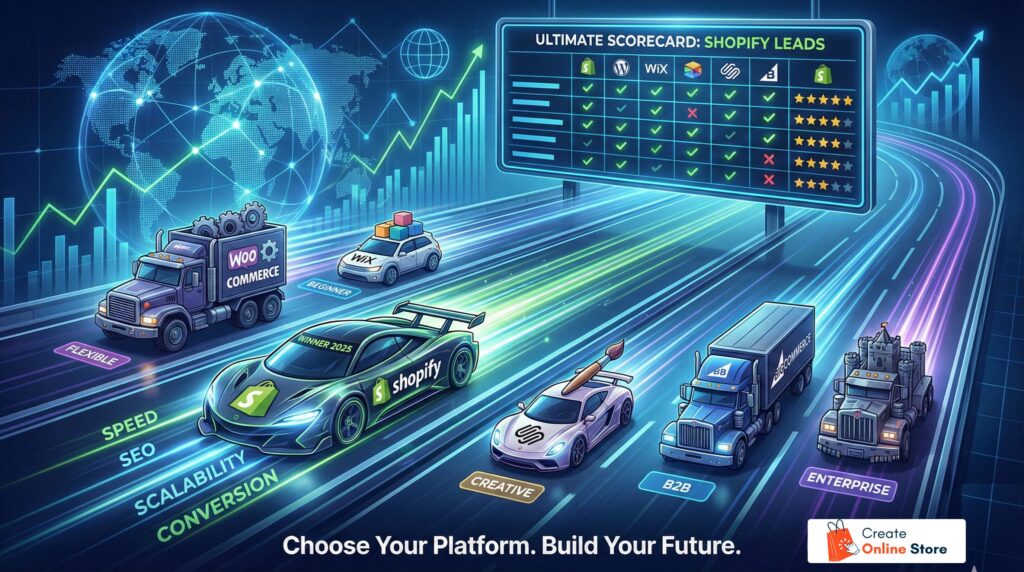
Before diving deep, here’s a high-level snapshot:
| Platform | Best For | Ease of Use | SEO | Performance | Scalability | Overall Rating |
|---|---|---|---|---|---|---|
| Shopify | All types of stores | ★★★★★ | ★★★★☆ | ★★★★★ | Very High | 9.5/10 |
| WooCommerce | Customizable stores | ★★★★☆ | ★★★★★ | ★★★★☆ | High | 8.2/10 |
| Wix | Beginners & small stores | ★★★★☆ | ★★★☆☆ | ★★★★☆ | Low | 7.8/10 |
| Squarespace | Creative brands | ★★★★☆ | ★★★★☆ | ★★★★★ | Medium | 7.9/10 |
| BigCommerce | Mid-large stores | ★★★☆☆ | ★★★★★ | ★★★★★ | High | 8.8/10 |
| Magento (Adobe) | Enterprise | ★★☆☆☆ | ★★★★☆ | ★★★★★ | Enterprise | 8.6/10 |
| OpenCart / PrestaShop | Developers | ★★★☆☆ | ★★★☆☆ | ★★★★☆ | Medium | 7/10 |
This single table already shows you the overall trend: Shopify leads as a balanced, scalable, and future-proof choice for most merchants. Now, let’s go deep.
Shopify — Complete Breakdown (Strengths, Weaknesses, Costs)
Shopify is the world’s most preferred eCommerce platform for one reason: it eliminates all technical headaches while giving you enterprise-grade performance. Below is a detailed breakdown.
2.1 Shopify Pros
| # | Pro | Details |
|---|---|---|
| 1 | Best Store Speed & Performance | Shopify is built on a globally distributed cloud network optimized for eCommerce. – Even a 1-second delay can reduce conversions by 7%. – Server uptime: 99.99% – Global CDN included – Automatic caching – Lightning-fast checkout |
| 2 | Best Checkout Experience in the Industry | Shop Pay converts 15–20% higher than normal checkouts. – Ultra-optimized for conversion – One-page checkout – Built-in fraud checks – Supports Apple Pay, Google Pay, Shop Pay |
| 3 | Incredible Theme & Design Ecosystem | Over 100+ premium themes with a modern drag-and-drop customizer. Fully responsive, fast, and built for high conversion. |
| 4 | App Ecosystem (10,000+ Apps) | Shopify supports almost every feature you can imagine: Marketing, Automation, Product Reviews, Shipping, Inventory Sync, AI Tools, and more. |
| 5 | Best for Scaling | Automatic scaling with no server maintenance. Handles thousands of SKUs and high order volumes globally. |
| 6 | Security + PCI Compliance Built-In | No manual updates, no patches, no server management. PCI compliance is fully included. |
| 7 | Professional Support | 24/7 support + extensive documentation + huge Partner ecosystem. |
2.2 Shopify Cons (Realistic Limitations)
| # | Con | Details |
|---|---|---|
| 1 | Monthly cost can rise with apps | Relying on multiple apps increases total monthly cost. Still cheaper than custom development. |
| 2 | Limited backend customization | Shopify is not open-source. Extreme custom backend systems may be better on WooCommerce or Magento. |
| 3 | Transaction fees (if not using Shopify Payments) | If Shopify Payments is unavailable in your country, transaction fees apply. |
1. Best Store Speed & Performance
Shopify is built on a globally distributed cloud network optimized for eCommerce. Even a 1-second delay can reduce conversions by 7%, which makes Shopify’s speed a major competitive advantage.
- Server uptime: 99.99%
- CDN included globally
- Automatic caching
- Lightning-fast checkout
2. The Best Checkout Experience in the Industry
Shop Pay converts up to 15–20% higher than normal checkouts.
- Ultra-optimized conversion
- One-page checkout
- Built-in fraud checks
- Apple Pay, Google Pay, Shop Pay
3. Incredible Theme & Design Ecosystem
With 100+ premium themes in Shopify Theme Store, you get a fully responsive, drag-and-drop customizer that supports modern UI.
4. App Ecosystem (10,000+ Apps)
It’s almost impossible to find a feature Shopify doesn’t already support: Marketing, Automation, Product reviews, Shipping, Inventory sync, and AI-product descriptions are all available via apps.
5. Best for Scaling
Shopify scales automatically — no server upgrades, no hosting maintenance. It handles thousands of SKUs and orders per minute, built for global expansion.
6. Security + PCI Compliance Built In
Unlike WooCommerce and others, you have No manual updates, no patches, no server management, and PCI compliance is included.
7. Professional Support
You get 24/7 support, extensive documentation, and a huge Partner ecosystem.
2.2 Shopify Cons (Realistic Limitations)
1. Monthly cost can rise with apps
If you rely on many apps, your cost increases. However, it still stays cheaper than custom development.
2. Limited backend customization
Shopify is not open-source. If you need extremely custom backend systems, WooCommerce or Magento may suit you better.
3. Transaction fees (only if not using Shopify Payments)
If your country doesn’t support Shopify Payments, you may pay 1–2% extra.
2.3 Shopify Pricing (2025 Updated)
| Plan | Monthly Price | Best For |
| Basic Shopify | $39 | New stores |
| Shopify | $105 | Growing stores |
| Advanced Shopify | $399 | Scaling brands |
| Shopify Plus | $2,300+ | Enterprise stores |
Section 3: WooCommerce — Deep Breakdown
WooCommerce powers millions of stores because it’s free, flexible, and open-source. But it requires technical management.
3.1 WooCommerce Pros
1. 100% customizable backend
Perfect for developers who need full control over the database, API, and checkout functions.
2. No monthly platform fee
WooCommerce is free. (BUT… Hosting, security, themes, and plugins add real cost).
3. Massive plugin ecosystem
60,000+ WordPress plugins support WooCommerce.
4. Excellent blogging + SEO
WordPress has the strongest blogging system in the world.
5. Ultimate Future-Proofing
Can be used as a “headless” backend for maximum speed (though this requires significant developer expertise).
3.2 WooCommerce Cons
1. Slow unless heavily optimized
You must manually optimize hosting, caching, minification, and database cleanup. Beginners struggle with this.
2. Security depends on you
You must maintain SSL, patches, updates, and firewall setups, making it more vulnerable to hacking attempts.
3. Costs add up quickly
Hosting, premium plugins, security tools, and developer fees often make it more expensive than Shopify long-term.
4. Not ideal for scaling
High traffic requires expensive servers and constant developer support.
Section 4: Wix eCommerce — Deep Breakdown
Wix is one of the easiest platforms for beginners. But while Wix is excellent for small stores, it is not built for serious eCommerce scaling.
4.1 Wix Pros
1. Easiest website builder in the world
Wix uses a true drag-and-drop interface, giving beginners a very simple website creation experience.
2. All-in-one platform
Wix includes hosting, SSL, templates, and basic tools. No external tools are required for small stores.
3. Affordable pricing
Wix plans are cheaper than Shopify and BigCommerce.
4.2 Wix Cons
1. Poor scalability
Wix is not built for high order volume or large catalogs. It generally struggles past $150k in annual revenue or 500 SKUs. Once a store starts growing, owners usually migrate away from Wix.
2. Limited SEO performance
Sluggish backend, heavy code, and limited control over technical SEO.
3. Basic eCommerce features
Wix lacks advanced functionalities like complex product options or multi-store setups.
4. App ecosystem is limited
Relatively small compared to Shopify’s 10,000+ apps.
Section 5: Squarespace — Deep Breakdown
Squarespace is a design-forward platform known for elegant templates, popular among photographers, artists, and lifestyle brands.
5.1 Squarespace Pros
1. Best design templates in the world
Visually superior templates, perfect for creative portfolios and aesthetic product brands.
2. Simple & intuitive editor
Cleaner and more professional than a fully drag-and-drop editor.
3. Good built-in features
Includes blogging, basic SEO, digital product support, and scheduling.
5.2 Squarespace Cons
1. Weak for large eCommerce
Not designed for multi-location inventory, advanced shipping logic, or large catalogs.
2. Very limited app marketplace
Unlike Shopify’s ecosystem, Squarespace extensions are limited.
3. Performance is average
Speed is good but not outstanding compared to Shopify’s optimized cloud hosting.
Section 6: BigCommerce — Deep Breakdown
BigCommerce is Shopify’s most serious competitor for mid-size and enterprise-level stores.
6.1 BigCommerce Pros
1. Extremely feature-rich
Includes features natively that Shopify requires apps for (advanced product variants, multi-currency support, B2B features). Excellent for large SKU stores.
2. No transaction fees
Does not charge additional gateway fees.
3. Strong SEO
Allows advanced URL structure, custom schema, and server-side rendering.
4. Good performance
Robust hosting handles high traffic well.
6.2 BigCommerce Cons
1. Much harder to use than Shopify
The dashboard overwhelms beginners.
2. Theme editor is weaker
Not as intuitive as Shopify’s Online Store 2.0 editor.
3. Annual sales limit
Each plan has a revenue cap, which can feel restrictive as you are auto-upgraded.
4. App ecosystem smaller than Shopify
Still good, but nowhere near Shopify’s library.
Section 7: Magento (Adobe Commerce) — Deep Breakdown
Magento (now Adobe Commerce) is a powerhouse built for enterprise-grade operations. It is extremely flexible, extremely powerful — and extremely expensive.
7.1 Magento Pros
1. Unlimited customization
Fully open-source (Magento Open Source version) allows complete control over checkout flow, database, and custom extensions.
2. Enterprise-grade performance
Handles millions of products, global storefronts, and sophisticated catalog rules.
3. Extremely powerful B2B module
Best B2B features: custom pricing, quotes, volume discounts, and corporate accounts.
4. Multi-store & multi-language support
You can run many stores from one backend.
7.2 Magento Cons
1. Extremely expensive
A typical Magento store costs $40,000–$250,000 to build and $2,000–$10,000 per month to maintain. Unrealistic for small or medium businesses.
2. Updates break things
Upgrades often require expensive developers to fix compatibility issues.
3. Slow development
Even small changes require coding expertise.
Direct Head-to-Head Comparisons (Most Valuable Section)
Section 8: Shopify vs WooCommerce
| Feature | Shopify | WooCommerce |
| Ease of Use | ⭐⭐⭐⭐⭐ | ⭐⭐ |
| Speed | ⭐⭐⭐⭐⭐ | ⭐⭐⭐ |
| Security | Built-in | Manual |
| Customization | Medium | Very High |
| Scaling | Automatic | Manual |
Final Verdict: Shopify vs WooCommerce
- If you’re non-technical → Choose Shopify
- If you want complete control → Choose WooCommerce
- If you want fast scaling → Choose Shopify
Section 9: Shopify vs Wix
| Feature | Shopify | Wix |
| eCommerce Power | ⭐⭐⭐⭐⭐ | ⭐⭐⭐ |
| Ease of Use | ⭐⭐⭐⭐ | ⭐⭐⭐⭐⭐ |
| SEO | ⭐⭐⭐⭐⭐ | ⭐⭐ |
| Scalability | High | Low |
| Design freedom | Medium | Very High |
Final Verdict: Shopify vs Wix
- For beginner hobby stores → Wix
- For real eCommerce businesses → Shopify
Section 10: Shopify vs Squarespace
| Feature | Shopify | Squarespace |
| Design Quality | ⭐⭐⭐⭐ | ⭐⭐⭐⭐⭐ |
| eCommerce tools | ⭐⭐⭐⭐⭐ | ⭐⭐⭐ |
| Apps | Huge | Limited |
| Scaling | Excellent | Moderate |
Final Verdict: Shopify vs Squarespace
- For creative portfolios that sell a few items → Squarespace
- For serious eCommerce growth → Shopify
Section 11: Shopify vs BigCommerce
| Feature | Shopify | BigCommerce |
| Ease of Use | ⭐⭐⭐⭐⭐ | ⭐⭐⭐ |
| Built-in features | Medium | Very High |
| Checkout | Best in class | Good |
| Pricing | Fixed | Sales-based tiers |
Final Verdict: Shopify vs BigCommerce
- For large B2B catalogs → BigCommerce
- For most D2C brands, ease, speed, and conversions → Shopify
Section 12: Shopify vs Magento (Adobe Commerce)
| Feature | Shopify | Magento |
| Ease of Use | ⭐⭐⭐⭐⭐ | ⭐ |
| Cost | Medium | Very High |
| Maintenance | None | Heavy |
| Scaling | Excellent | Enterprise-level |
Crucial Note on Scaling: Shopify Plus ($2,300+/month) is the platform’s true answer to Magento for large enterprises, offering similar customizability with dedicated account management, but with far less maintenance headache.
Final Verdict: Shopify vs Magento
- For complex B2B/ERP workflows → Magento
- For fast-to-market D2C or large brands seeking low-stress maintenance → Shopify
13. Shopify vs Competitors — Side-By-Side Summary (2025)
After comparing Shopify with every major platform, here’s the ultimate scorecard:
| Platform | Ease of Use | Customization | SEO | Speed | Scalability | Affordability/Barrier | Apps | Overall |
| Shopify | 10 | 8 | 10 | 10 | 10 | 7 | 10 | 9.4 |
| WooCommerce | 6 | 10 | 8 | 6 | 8 | 9 | 8 | 7.9 |
| Wix | 10 | 5 | 6 | 8 | 5 | 9 | 6 | 7.1 |
| Squarespace | 9 | 6 | 7 | 8 | 6 | 8 | 6 | 7.3 |
| BigCommerce | 8 | 7 | 9 | 9 | 10 | 7 | 7 | 8.4 |
| Magento | 3 | 10 | 9 | 9 | 10 | 2 | 6 | 7.1 |
| Custom Store | 2 | 10 | 10 | 10 | 10 | 1 | 2 | 6.4 |
14. Which Platform Should You Choose? (Decision Matrix)
14.1 Choose Shopify If You Want:
A store ready in hours, not months, best page speed, best mobile checkout, seamless scaling, and zero maintenance.
- Ideal for: Dropshipping brands, D2C startups, fast-growing companies, and international sellers.
14.2 Choose WooCommerce If You Want:
Full control over your website, access to custom PHP, and deep customization.
- Ideal for: Content-heavy sites, custom checkout flows, and tech-savvy users.
- Not ideal for: High-traffic stores or beginners.
14.3 Choose Wix If You Want:
A simple drag-and-drop builder, a small store with < 50 products, and very simple setup.
- Not recommended for: Large stores, fast scaling, or serious SEO.
14.4 Choose Squarespace If You Want:
Beautiful, minimalist designs, and a creative or portfolio-first brand.
- Not suited for: High-order-volume or inventory-heavy stores.
14.5 Choose BigCommerce If You Want:
Enterprise-level scalability and built-in features like multi-channel selling and complex shipping.
- Issue: Pricing grows with sales, and the learning curve is higher.
15. Pricing Breakdown (Realistic 2025 Cost)
| Cost Type | Shopify Realistic Yearly Cost | WooCommerce Realistic Yearly Cost | Magento Realistic Yearly Cost |
| Total | $800 – $3,000 | $1,000 – $5,000 | $20,000 – $200,000+ |
| Notes | Transaction fees are 0% with Shopify Payments | Includes hosting, plugins, and maintenance fees | Includes high development and ongoing maintenance fees |
16. Final Decision Framework (Choose in 5 Questions)
Answer these 5 questions honestly:
1️⃣ Are you technical?
- NO → Shopify or Wix
- YES → WooCommerce or Magento
2️⃣ What is your budget?
- < $1000 → Wix / Shopify Basic
- $1000 – $5000 → Shopify / WooCommerce
- $50,000+ → Magento / Custom
3️⃣ How fast do you want to launch?
- 1 day → Wix
- 3–7 days → Shopify
4️⃣ What is your product volume?
- < 50 → Wix or Squarespace
- 50–5,000 → Shopify or WooCommerce
5️⃣ How important is future scalability?
- High → Shopify / BigCommerce / Magento
- Low → Wix / Squarespace
17. Final Verdict — Which Platform Wins Overall?
After all comparisons: Shopify is the best all-in-one solution for 90% of online stores in 2025.
Not because it is “popular,” but because it delivers the critical combination of ease of use + enterprise reliability that no other platform can match:
- The fastest platform
- The most secure
- Best mobile checkout
- Zero maintenance
- Scales automatically
18. Conclusion — Written for Your Website (Create Online Store)
Choosing the right eCommerce platform is not just a technical decision—it’s a business decision that affects your revenue, growth, and long-term scalability.
Shopify continues to dominate because it solves the problems that modern brands care about: Page speed, SEO, Checkout conversions, Security, and Scalability. And that’s why, for most entrepreneurs, Shopify provides the highest ROI with the lowest stress.
But the truth is simple: The best platform is the one that matches your business model.
If you want help understanding which platform suits your idea—or you want experts to build a complete Shopify store for you—